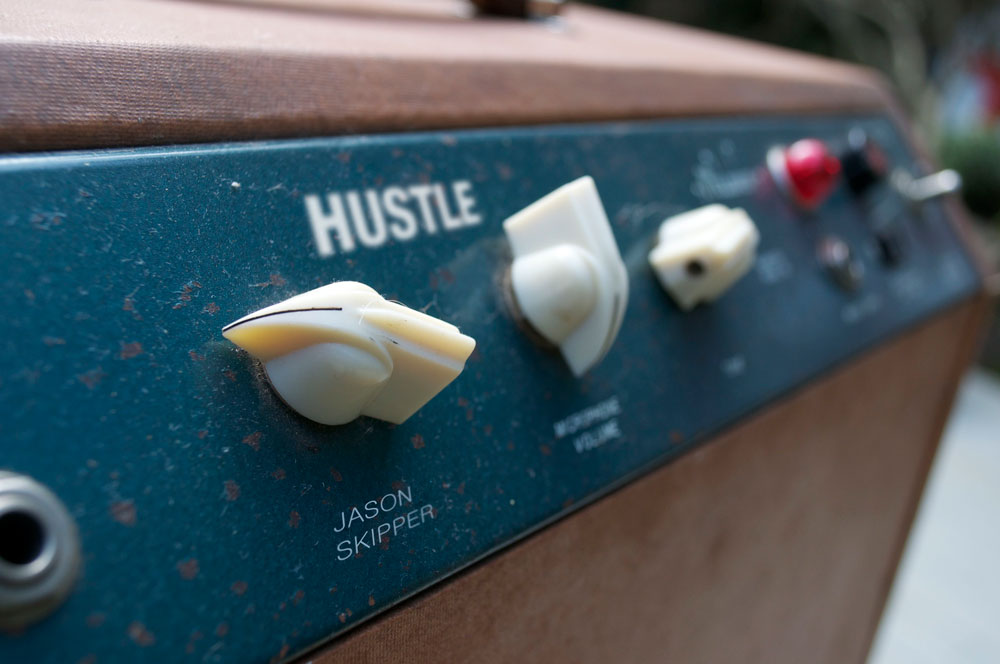
On Saturday, I read at The Book Cellar in Chicago with the the marvelous Kathleen Rooney. Kathy is the author of many books of poetry and prose and a founding editor of Rose Metal Press, a really good friend with huge amounts of energy that she puts toward making the book world better. She read Hustle five times in different versions, and helped to make sure it came into the world.
The Book Cellar is a really great store operated by Suzy Tacas. Suzy is one of the most enthusiastic and friendly booksellers I’ve ever met, not to mention unbelievably kind.
Also, it was great to see my old pal Adin Bookbinder, who is working on a terrific novel called The Boy Soprano. Here is a link to an interview she did with One-Story.
Thanks to Kathy and Suzy, and everyone who came out!
Here is Suzy:
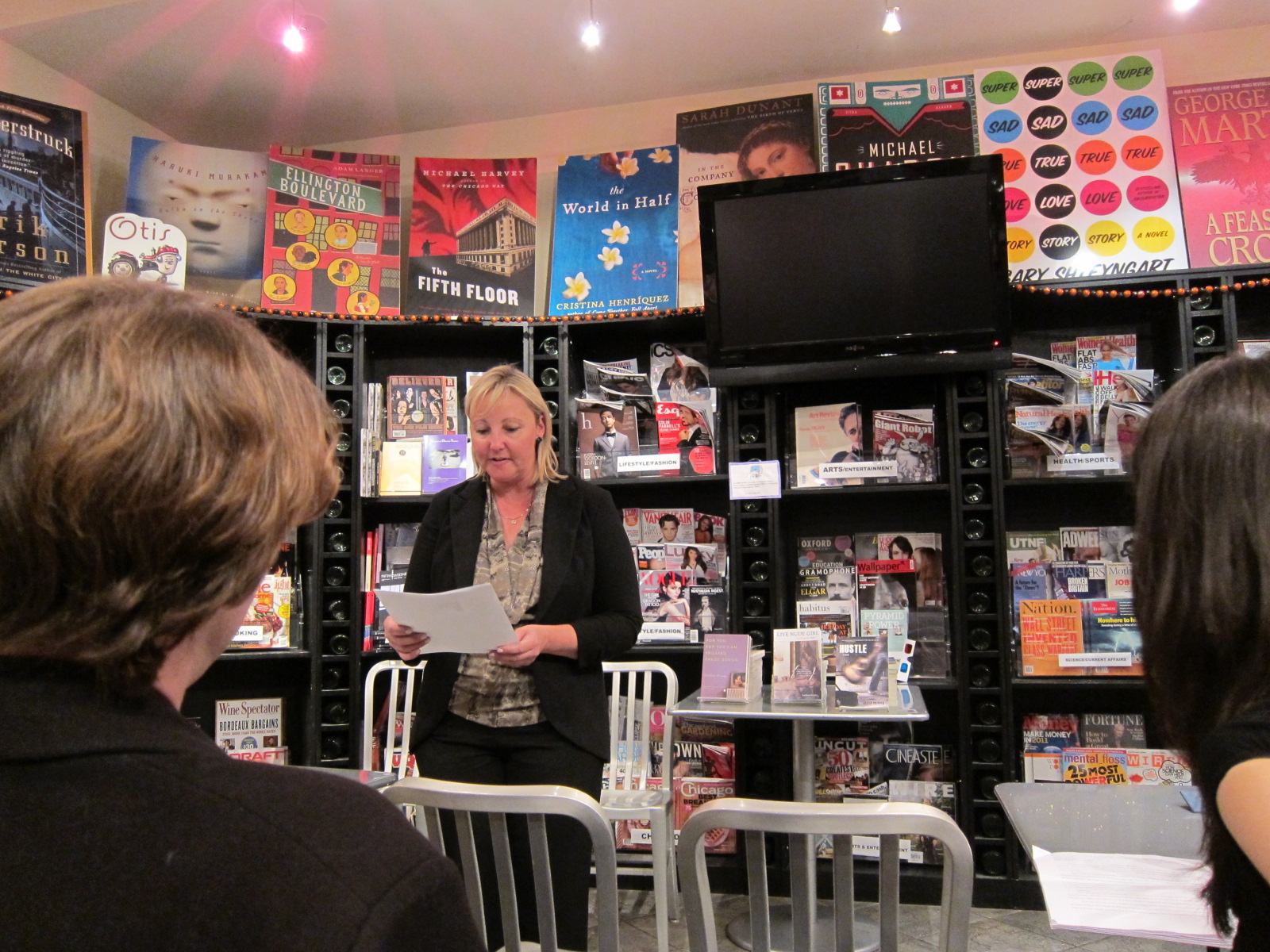
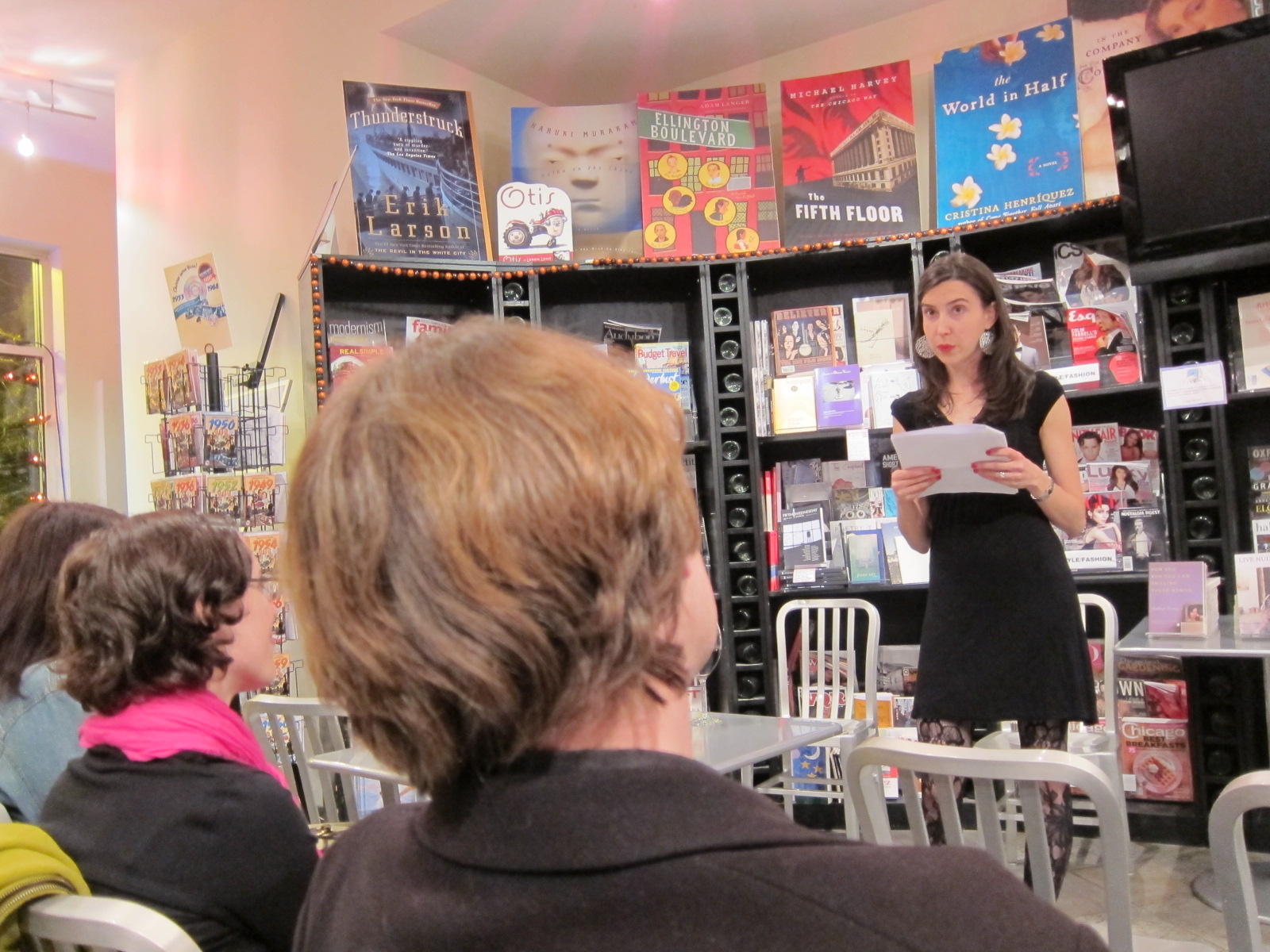
Here is Kathy reading:
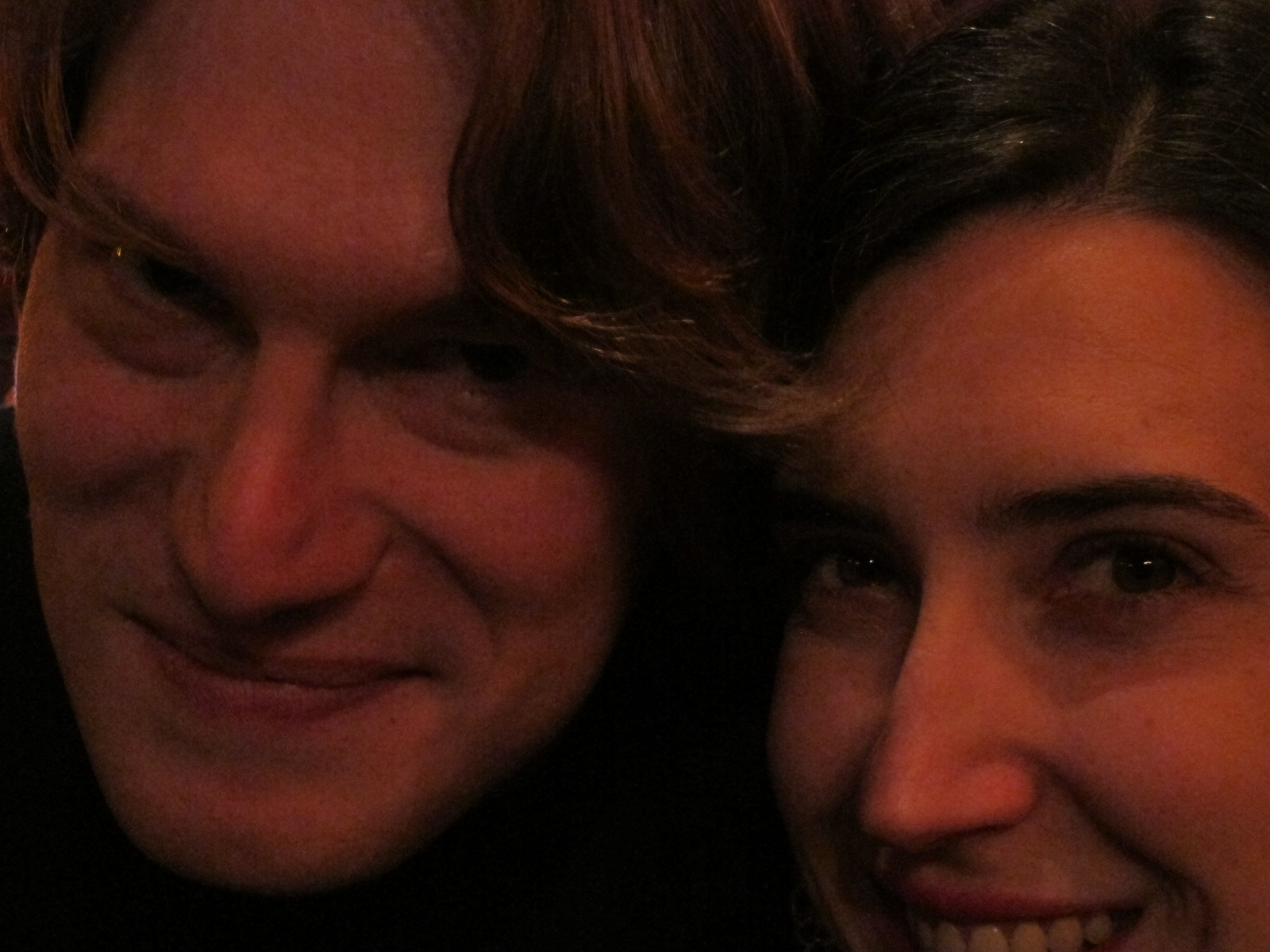
Here is Kathy with her husband, the writer Martin Seay:
On Thursday, I left the awful Minneapolis hotel and headed east. My original intent had been to go straight through to Chicago, where I was set to read on Saturday, but I had found out that Rhett Miller (singer for the Old 97’s, who appears as a character in Hustle at a pivotal point in the central character Chris Saxton’s life) was playing an acoustic show in Madison. I decided to stop off, grab a hotel and a ticket, and take some downtime after what’s felt like two weeks of constant going. It was nice to only drive four hours, and I arrived in time to go for a run. On actual pavement.
The evening was terrific. Alex Dezen, of The Damnwells was great, as was Rhett. I was able to get a copy of the novel to him afterward, and hang out for a bit.


Also, I met and spoke with Alex, who is apparently a recent graduate of the Iowa Writer’s Workshop, currently writing what sounds like a phenomenal and unique novel.
First off: the awesome write-up from the Minneapolis Star Tribune, that came out the Sunday while I was still in Iowa. Read it here.
Pulling into town, the sunset made the sky appear to be on fire, and there was a place on I-35 that sells huge sculptures of great white sharks. It was a bit late in the day when I arrived at my (let’s face it: awful) hotel, but I was determined to head for the fitness room to use the treadmill (I hadn’t run in about a week). Unfortunately, the treadmill was ancient, with a narrow belt that stuck every few steps; fortunately, it had railings, because I needed to use them five times to prevent myself from falling. My room was awful because the walls were paper thin and, like many motels I’ve visited, it smelled like walking through a cloud of baby powder and carpet cleaner. Also, every uncarpeted surface was slick: the lobby, the elevator, my bathroom. Luckily, though I get lost a lot (as I am about to speak to), I am fast not to fall.
That next day, I did my first radio interview. The University of Minneapolis radio station, KFAI, features a program called WRITE ON! where visiting writers read a bit from their work and take questions. With Steve McEllistrem, I talked about what inspired Hustle, its characters, and my writing process. The half-hour flew by. I believe it is scheduled to air later this autumn.

That afternoon I went to the Minneapolis Institute of the Arts, which – along with their stunning collection – had an exhibit that focused on Dante’s Inferno, featuring sections of Robert Pinsky’s translation alongside drawings done by Mazar, which had helped Pinksy to envision the original and shape his translation.
That night, I had my reading at the bookstore Magers and Quinn. I have discovered on this trip that I get lost, a LOT. Every day, I make at least one wrong turn, take one wrong exit, or find myself in a store unable to remember what I came for. When I left Hawarden, one of the last things Jennifer said to me was: “You know which way you’re going?” And I said, “Yes.” Then I left the parking lot, heading south instead of north, making it all the way to Sioux City (30 miles) before realizing my mistake. Luckily, I got some good pictures. On this evening, my GPS led me astray and I found myself downtown with my car parked in a garage, and the bookstore nowhere in sight. I hailed a taxi and and the driver explained that the store was uptown, and I was about a half hour away! I hopped in and we sped across town until we finally arrived at the Magers & Quinn, with about two minutes to spare.
I met with my reading partner for the night, Peter Geye, a longtime pal from Western Michigan University and author of the award-winning novel Safe from the Sea. We each read for twenty minutes and took questions, mainly about our time at WMU, writing our novels, and our research approaches with our current projects.

Afterward we went out to a place called the Cafeteria with Peter’s wife, Dana, and the terrific writers Kate Ledger (author of Remedies) and Matthew Batt (author of the forthcoming memoir Sugarhouse). It was great to meet so many new people and to see Dana and Pete, and I am so excited to see how his new book turns out. Thanks to Magers & Quinn, to everyone who set up the event, and to everyone who came out!


On the heels of my trip to Portland, I left Washington on Tuesday, October 11 for a trip to the Midwest. The trip is scheduled to take a total of nineteen days, with the first part devoted to research on my new project, and the latter intended for readings (in Minneapolis, Chicago, and Oxford, Ohio) to promote Hustle.
For the research portion – after driving through Iowa City to see my friend Deborah Kennedy, currently in the Iowa Writer’s Workshop – I spent several days in Hawarden, Iowa.

Hawarden is a small “ag” town, deep in the ocean of corn and soybean fields along the southern edge of the state. My father spent his early life here, first in a smaller town called Newcastle, Nebraska with his mother, and then – after moving to Florida to be with his father – in Hawarden, where his mother and stepfather had moved, and where he was married here for a while. I stayed at the Hawarden Harvest Inn – owned and operated by my Uncle Bill and Aunt Jennifer – talking to people during the day and writing at night.
Over the week, I mainly got a feel for the topography and spent time interviewing people who knew my father: his brother (Bill), his first son (Michael), the sisters of his first wife (Kathy and Pat), his cousin (Georjean), his uncle (Toke), and my aunt (Jennifer) who knew many stories about my father, told by people she knew.

Bill and Jennifer
I drove around and took pictures and walked the leaf-covered streets in the small suburb, and up the three-block main street.

I also visited Newcastle – just south of Hawarden, where my paternal grandmother grew up, where her father was a farmer and a whiskey-still operator, and where my father lived with his twin and older sister for nine years.
Mainly I gathered stories. Watched the way the sun set on the fields. Felt the weather turn as fall set in, while the temperatures dropped into the thirties, the leaves changed further, and the cold set in on my knuckles.
Also, I rode a combine through a cornfield with a guy named Davey. I got to see how a gravel pit is operated. I learned how power lines – which my father worked on – are constructed. I learned about the Soo Motel, that my grandparents operated.

I was a sad to pull my rental car away from the Harvest Inn on Wednesday afternoon. I feel grateful to all of the people who spent time talking to me and showing me around. But I have a feeling, as this story further unfolds, that I will soon return.

Portland is one of my favorite cities on the planet. Here is why:
1.) I love Powell’s. It’s a sight to behold, this city-block sized bookstore. Everyone goes on about it so, I will not.
2.) Once, while at a farmer’s market, I had my palm read by an elderly woman while sitting on an upside down paint bucket under a tarp, and what she said tweaked me out for a month.
3.) I once waited 100 hours to eat at a restaurant and had pumpkin enchiladas that almost made me fall from my chair.
4.) Great guitar shops downtown.
5.) Reed College is nearby, which hosts the Tin House writer’s conference (and has a terrific reading series).
6.) Wordstock.
Wordstock is an annual, two-day literary festival that features readings, panels, and writing workshops. It is the largest event of its kind in the region, and it’s aMAzing, particularly because of the workshops. Unlike many festivals, which tend to feature only panels and readings, goers can take quick workshops by well known authors; for instance, Benjamin Percy’s workshop last year on using tropes as the building blocks of plot, character, and thematic development and Baharati Mukhuerjee’s workshop this year on self-editing.

This year, I was invited to Wordstock to read, sit on a panel, and teach a workshop. Talk about a huge honor. I was beyond excited.
Driving to Portland is usually fun, but this time it was nuts. While driving through Olympia something fell from an overpass and smashed into my windshield. It FELT like a brick, and a small crack emerged at the bottom of the glass. I watched as it trickled upward while I drove, and it became increasingly clear that I might need to call and say I couldn’t make it because my windshield was gone. But I drove with my fingers crossed, eyeing my GPS, until finally – thankfully – I crossed the Columbia River separating Washington from Oregon. Pulling into Portland, my GPS steered me the wrong way, but intuition led me to the convention center where I was set to read. I parked my car and ran inside.
Soon I met Mellisa Huggins, my former student, a terrific writer, and now an Eastern Washington University MFA grad who coordinates the GetLit Festival in Spokane (a festival that also features workshops), and then I met my reading partner Manuel Munoz. I read first, and he went after, reading a scene from his terrific novel, What You See in the Dark, where a 23 year old woman has sex with a younger man for his first time in a car at a drive-in. We then took questions about capturing certain settings/locations in certain time periods and how to structure books. He is a phenomenal reader with great pacing, and a very articulate way of talking about writing.


We were then whisked away to the author signing area, which was interesting and – I think – a smart thing to have, where writers sat at tables and signed books and talked with people. Afterward, we went to see Marjorie Sandor and Cheryl Lu-Lien Tan read.
It was approaching evening, and I was wiped out from the three hour adrenaline rush that came from the drive+reading, so I wanted to get to my hotel room. I found my Jeep and drove over to my hotel, a place called the Inn at the Convention Center, caught up on baseball and worked on my talk for the morning’s panel.
Sunday morning, I took part in a panel with publicist Mary Bisbee-Beek and fellow first-time authors Scott Sparling and Ellen Meeropol, where we talked about the process of publishing our books, mainly focusing on the ups and downs of the process, going from the early stages of writing the books to working like crazy to promote the books after they were published. Both of them are dazzling, and their books are phenomenal. Crazy how much ground we covered in that hour, and how much we had in common – mainly that all of us most seem to really appreciate the bookstores that have done so much for the books.
At the author signing station (as I came to call it), I found myself seated beside Steve Almond, a writer who came to PLU to read a few years ago and I interviewed for Third Coast last year, whose spirit and work I greatly admire. Students were talking about that reading for years.
Finally, at 3pm I did my workshop, which focused on ways to bring point-of-view into setting. I had expected only a few people, and was surprised that 28 people filled the room! They were a lively and fun group, with everyone speaking up in the discussion and everyone game as we went through the writing exercises. What was even more fantastic was the writing they produced. GOOD LORD!! Three people read, and all three pieces were completely different, but all three were really terrific in their own ways.
I will now admit, I was incredibly nervous about every part of Wordstock, leading up to each event. I had never done a reading at a conference, or a panel with other writers, or a workshop outside of my own students. But the experience was terrific.
Afterward, I left and went to Walgreens and got clear nail polish, applied it to the crack on my windshield and headed home, listening to Led Zeppelin and Love as Laughter.
Now I have to go mow the lawn. In the rain, wearing my surgical mask. Then I have to pack my massive red suitcase and get ready to head out to the Midwest for 2.5 weeks to work on my new project.
I will post some as I go.
For the past couple weeks, I have been back in Tacoma, mainly working on stories (for a Tacoma-based book) and sections of my new book (nonfiction). I have also been getting everything nailed down for my trip to the Midwest, where I am seeing friends and family and interviewing people for the new nonfiction book, and I have readings in Minneapolis, Chicago, and at Miami of Ohio.
Also I have been preparing for Wordstock in Portland, where on Saturday 10/8 at 1pm I am reading with Manuel Munoz (author of What You See in the Dark), and on Sunday 10/9 at 11 a.m. I have a panel discussion on first-time book publishing with publicist Mary Bisbee-Beek and authors Ellen Meerpol (House Arrest) and Scott Sparling (Wire to Wire). On Scott’s site he has a video where he gives a great description of what it’s like to work on a book for many years, comparing it to cultivating a large ball of string. Awesome. Then at 3 pm I teach a workshop on writing setting.
I have also been bracing myself for my reading at the Garfield Book Company at Pacific Lutheran University, where I teach (though I am currently on sabbatical). I say bracing because I know my students, colleagues, and the people who come to these readings (I coordinate the Visiting Writer Series at PLU) can ask very intricate nuts and boltsy questions, and I wanted to make sure to do them right.
It was a great evening, and it was fun to see colleagues, friends, and former students in the audience. The questions I did get were:
1.) Which character from your book do you like the best?
2.) What is you approach to writing setting?
3.) What is the toughest part about the publication process?
4.) What is the difference between writing short stories and writing a novel?
Very fun. Thanks to Kelly and Lana for setting everything up!
Here are a couple pictures:

